
Reliable time synchronization for arenas, stadiums and sports complexes

Time Servers and Clock Systems for Sports Infrastructures
Stadiums and arenas hosting sporting events, concerts or large-scale cultural events require high-precision and reliable time synchronization to deliver a seamless experience for spectators, staff and broadcast media.
In sports venues where every second matters, accurate time management is essential to synchronize scoreboards, display systems, public announcements, live broadcasting and external media feeds. Reliable time synchronization ensures the smooth operation of competitions and events.
Why do stadiums, sports halls and aquatic centres need time synchronization solutions?
In sports infrastructures, time display systems and NTP synchronization of audiovisual, broadcasting and access control systems are critical to:
- ensure punctuality and reliability of sporting events
- provide real-time, accurate and readable information to spectators, teams and officials
- synchronize digital displays, video walls, broadcast systems and clocks in high-traffic venues
- enhance the overall spectator experience
- improve operational efficiency and contribute to venue safety and security
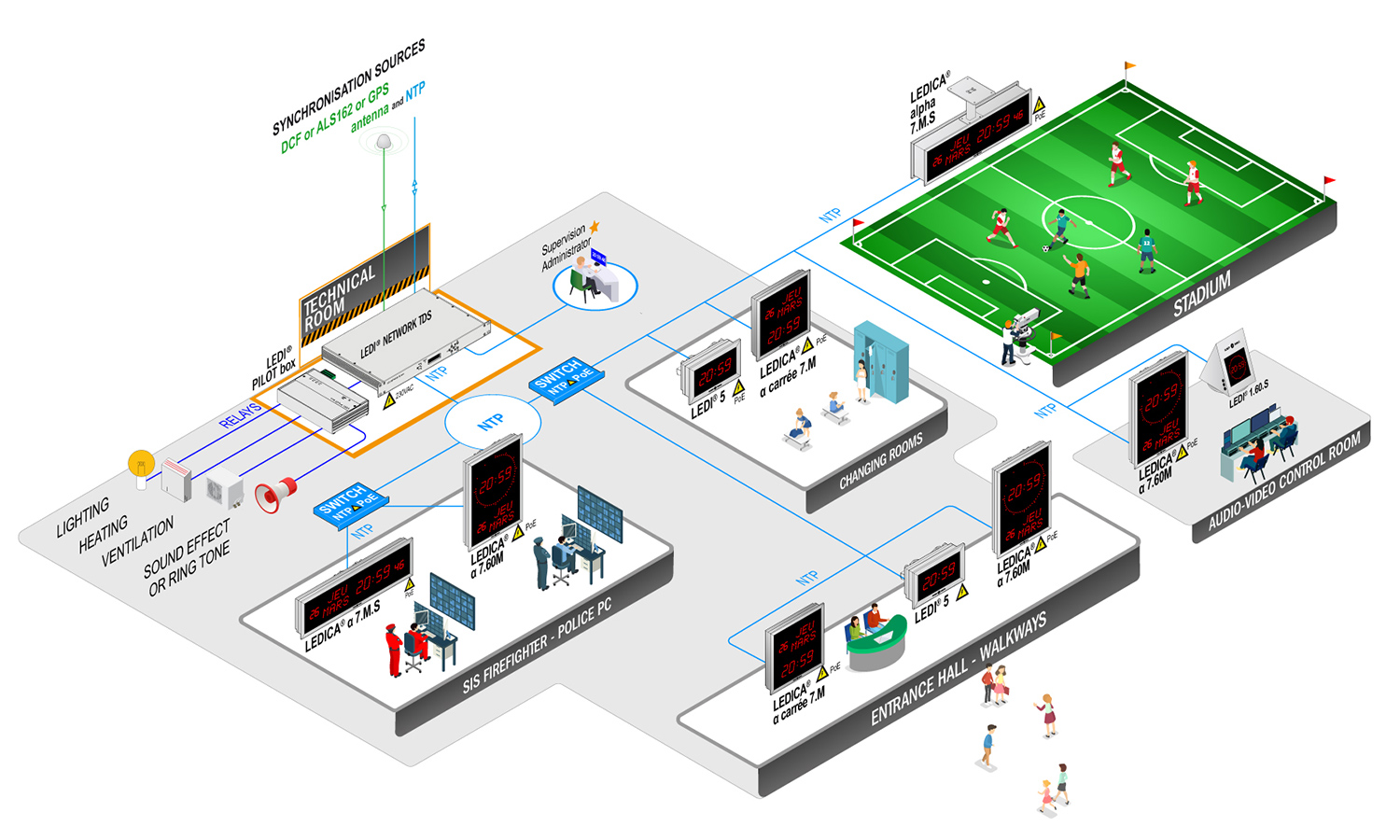
Stadiums
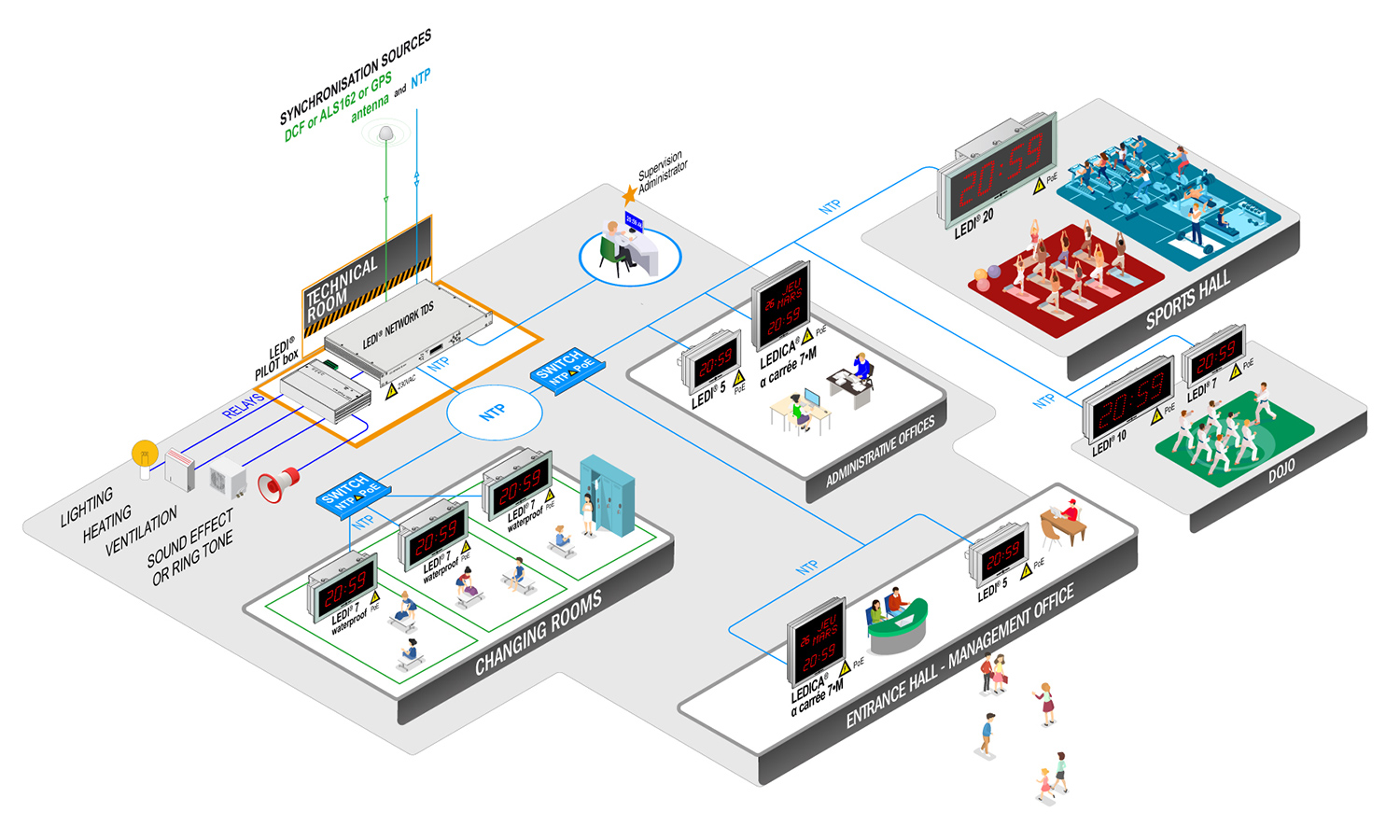
Sports Halls and Gymnasiums
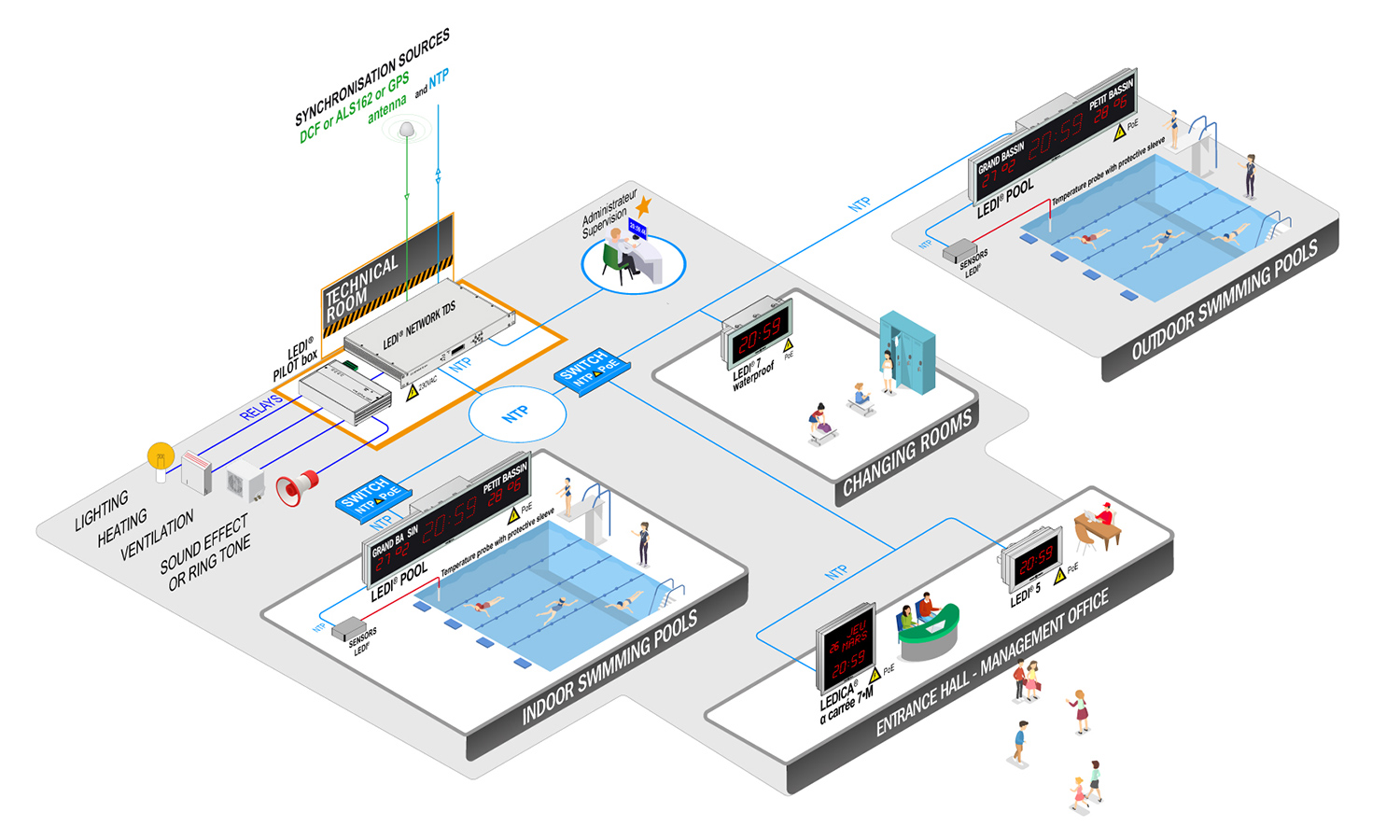
Swimming Pools
Time Servers for Sports Infrastructure Synchronization
Deploying a network time server (NTP) in sports infrastructures ensures accurate and secure synchronization of all IP-connected equipment, including clocks, ticketing systems, security cameras, access control systems and broadcast equipment.
Using industry-standard protocols such as NTP (Network Time Protocol), time servers deliver a consistent and unified time reference across the entire IT and AV infrastructure.
This centralised and secure time synchronization helps to:
- prevent time drift that could disrupt event scheduling
- optimise the performance of sports facilities
- improve the experience for spectators, athletes and staff
- strengthen cybersecurity and network integrity
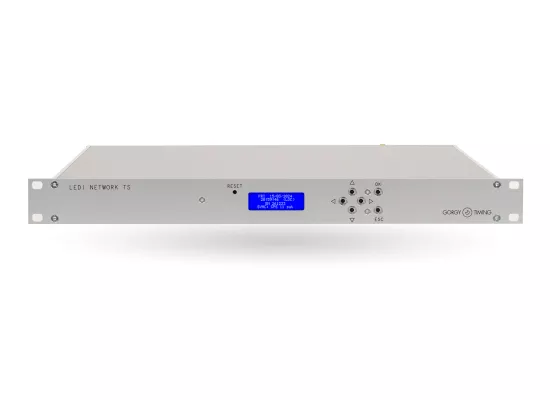
LEDI® NETWORK TS
Accurate time server, with supervised NTP output and Afnor coded time.
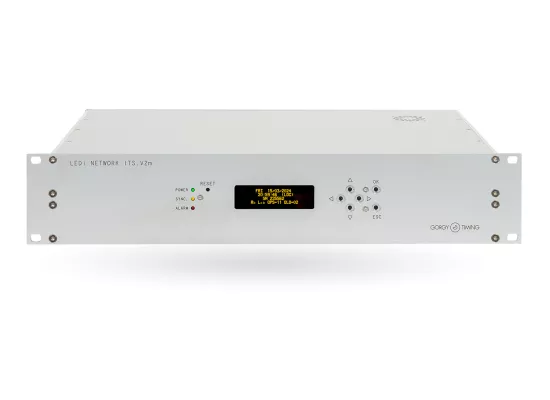
LEDI® NETWORK ITS V2M 2U
Highly accurate, secure 2U rack time server with multiple redundant synchronization inputs and multiple synchronization outputs.
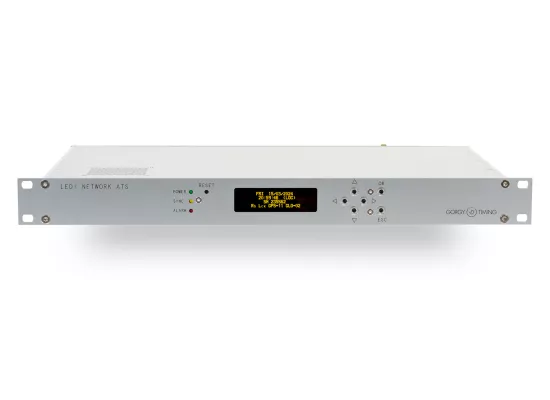
LEDI® NETWORK ATS
Highly accurate, secure time server with its internal base capable of providing a stable time signal even in holdover mode over long periods.
Analog and Digital Clocks in Stadiums and Arenas
Analog and digital clocks play a key role in coordinating activities within stadiums and arenas, where precise timekeeping is essential for the smooth running of sporting, cultural and logistical events.
Whether managing spectator flows, coordinating technical teams or synchronizing media broadcasts, the use of reliable and highly visible clocks—both indoors and outdoors—ensures efficient and well-controlled operations.
Analog clocks for quick and intuitive time reading
Thanks to their classic display, analog clocks offer immediate readability, making them ideal for access areas, hospitality suites, VIP lounges, technical rooms and service zones.
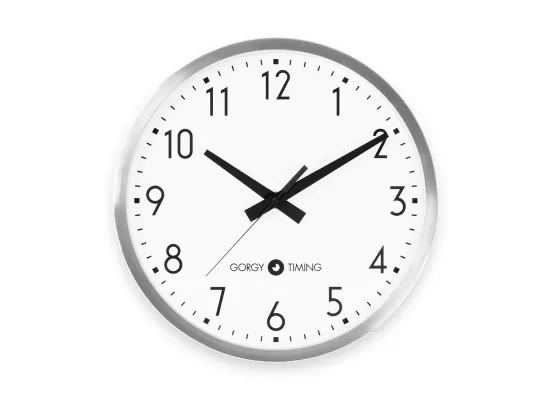
Renowned for their robustness and reliability, HANDI® analog clocks meet the strict visibility and durability requirements of sports infrastructures. Their design integrates seamlessly into stadium and arena architecture while ensuring clear time display in all conditions.
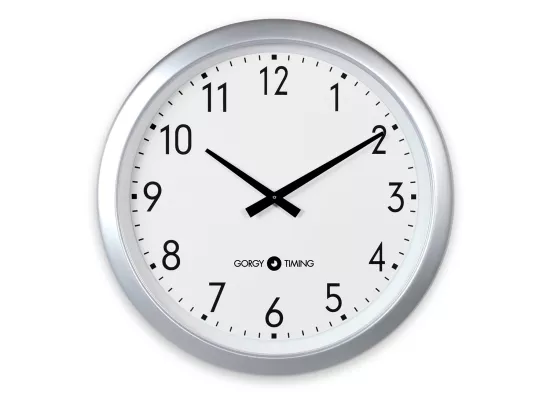
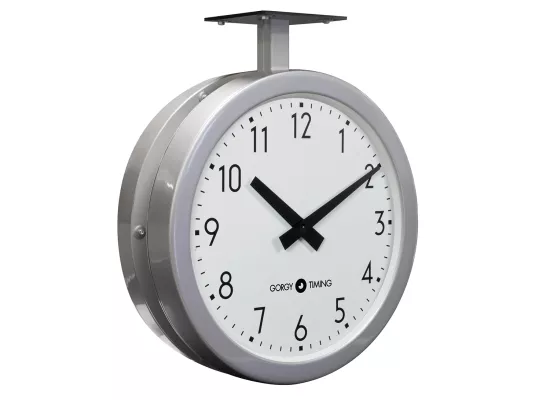
HANDI® 620 double-sided
Double-sided round analogue clock with a 60-cm diameter, for indoor or outdoor use.
Digital clocks for maximum visibility
LEDI® digital clocks provide outstanding display accuracy and excellent legibility, even from long distances. They are particularly suited for grandstands, entrance halls, circulation corridors, changing rooms and control rooms.
Their clear digital display enables effective synchronization of on-field and backstage operations, as well as live media broadcasting. They actively support coordination between internal teams, event organisers, referees and broadcasters.
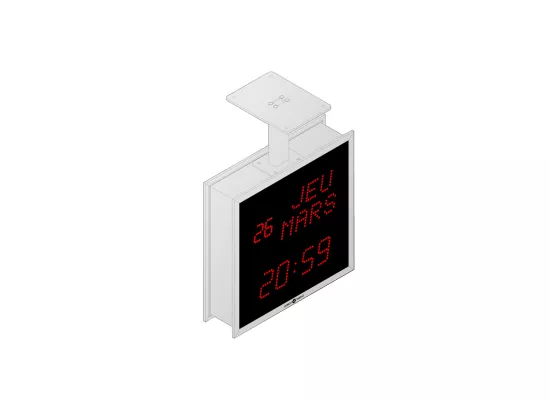
LEDICA® ALPHA SQUARE REVERSO 7.M
Professional tricolor LED calendar clock, for indoor use, double-sided, displaying date (alphanumeric), hours and minutes.
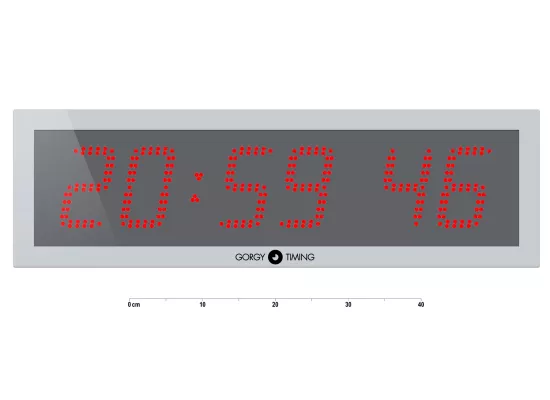
LEDI® 12.S OUTDOOR
Professional tricolor LED clock for indoor or outdoor use, single-sided, displaying hours, minutes and seconds.
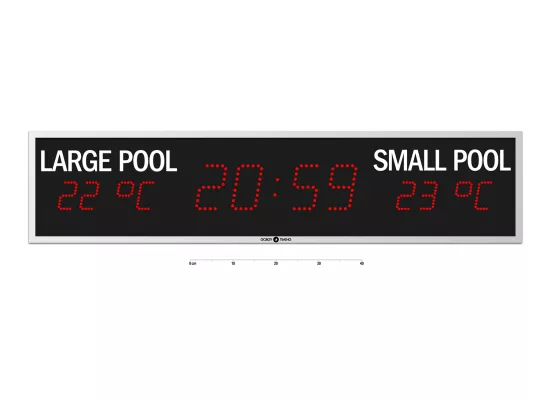
LEDI® POOL
Professional, single-sided, tricolor LED clock, displaying hours and minutes and water temperatures for one or 2 pools, with alternating air temperature.
Why choose Gorgy Time for your sports facilities?
With many years of expertise in time synchronization and display systems, we support sports infrastructures with solutions fully adapted to the specific constraints of stadiums and sports halls. By choosing Gorgy Time, you benefit from:
- a single, reliable time reference for all your equipment,
- a professional and robust design tailored to demanding environments,
- comprehensive project support, from audit and design to commissioning and ongoing maintenance.
FAQ : Time Synchronization in Sports Facilities
Does time synchronization contribute to the IT security of a sports facility?
A reliable and secure time reference is essential for IT security within sports infrastructures. It enables accurate event timestamping, improved incident analysis, effective log correlation and compliance with regulatory requirements. As a result, time synchronization plays a key role in strengthening the overall cybersecurity of stadiums, arenas and sports venues.
What are the key factors to consider when implementing a time synchronization system in a sports centre?
The implementation of a time synchronization system in a sports environment is based on several essential factors: the required display format (hours–minutes or hours–minutes–seconds), the size of the facility (multi-purpose sports complex, stadium, swimming pool or gymnasium), the existing network infrastructure (IP network, for example), as well as environmental constraints such as humidity, impacts and lighting conditions.
Which technology should be chosen between NTP and AFNOR for a sports complex?
The choice between NTP and AFNOR time synchronization mainly depends on the existing infrastructure. NTP is particularly well suited for sports complexes equipped with an IP network, as it allows efficient synchronization of clocks, servers, ticketing systems, security systems and display equipment.
AFNOR synchronization relies on a dedicated wired signal and enables time distribution over long distances without requiring connection to the sports complex’s IP network.
Are digital clocks protected against ball impacts?
Yes, digital clocks designed for sports environments are generally built to withstand repeated impacts, including ball strikes. They feature reinforced front panels made of polycarbonate or safety glass, combined with robust housings.
For installations located close to playing areas (gymnasiums, multi-sport halls), it is recommended to choose models certified for resistance to mechanical impacts.
Which IP protection rating should be chosen for a clock installed in a swimming pool or an outdoor stadium?
The IP protection rating is a critical selection criterion. In swimming pools or highly humid environments, an IP65 rating is recommended to protect the clock against moisture, water splashes and chlorinated products.
For outdoor stadiums, an IP54 rating is also suitable to ensure resistance to weather conditions, dust and temperature variations.
Which digit size should be chosen according to the viewing distance?
The choice of digit size depends directly on the viewing distance. For readability from the grandstands, large digits (from 10 cm and above) are required to ensure optimal visibility.
Conversely, for changing rooms, technical rooms or areas close to the playing field, smaller digits are sufficient (around 7 cm).